Melissa Hoyer
If the original The Devil Wears Prada was about getting in, the sequel is about staying relevant once you’re there. And that’s where it lands its smartest punch.
The Devil Wears Prada 2, starring Meryl Streep, Anne Hathaway, Emily Blunt and Stanley Tucci has landed, nearly 20 years after the release of the first. Directed by the 2006 film’s director David Frankel, the film – out in cinemas today – features the return of Miranda Priestly (Streep), Andy Sachs (Hathaway), Emily Charlton (Blunt) and Nigel Kipling (Tucci) back to the world of fashion in New York City.

This is still a highly entertaining, glossy, visually appealing return to the fashion world complete with sharp tailoring (Dior features prominently), immaculate sets, and that familiar whip-smart dialogue, but there’s a much more interesting undercurrent running through it than the frock show part of the equation.
The film leans into the reality that the magazine industry hasn’t just evolved, it’s been completely upended. Print no longer dictates culture in the same way; digital does. It also reminds any members of legacy media that their world has industrially revolted.
Fashion ‘influence’ is faster, more fragmented, and far less controllable and that tension sits at the heart of the TDWP2 story and gives it a sense of urgency the original never needed.
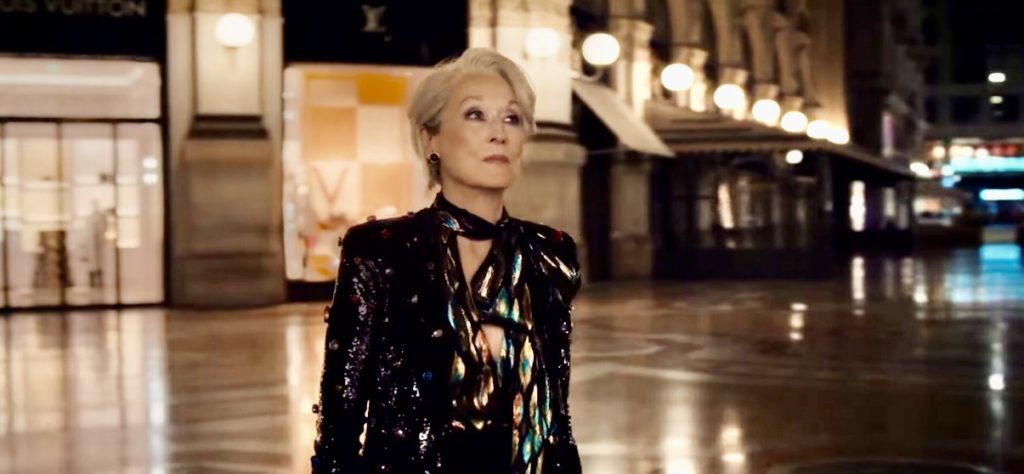
At the centre, Miranda Priestly (Ms Streep cosplaying Anna Wintour brilliantly) remains formidable, but she’s no longer operating from an unshakeable position of power. There’s been a subtle recalibration here – she’s still terrifyingly precise, but you really sense the ground has well and truly shifted beneath her.
It’s not a softness but more of an underlying awareness that she isn’t the anointed fashion media queen any longer.
The relationship she has with Andy Sachs (Hathaway) is still egg-shell-esque but Miranda slowly develops an admiration for her – even though Miranda is still a self-absorbed narcissist and Andy’s knowledge of the new media world and what people are really thinking ‘out there’ well surpasses hers.

The one thing I don’t quite believe in TDWP2 is the relationship Miranda has with her fourth husband Stuart, played by Kenneth Branagh. It just seem too tokenistic – the well, younger, ‘creative’ violinist married to the wise, shall we say, older woman? I guess it’s sticking with the current (& brilliant) trope I might add – the one of showcasing mature women in film land. (Hang on, don’t overthink it, it’s just a film Melissa!)
Meanwhile Andy is a product of the new media world. She’s sharper, more assured, and far less willing to be consumed by the machine she once fought to survive. Her relationship to the industry is more nuanced and she understands both its allure and its cost.
Hathaway’s screen chemistry is cute with Australian co-star, Patrick Brammall (of Colin from Accounts renown) who plays Andy’s new love interest – a ‘nice’ property developer (but isn’t that an oxymoron?)
That evolution gives the film some emotional weight, even when it’s moving at its brisk and polished pace.
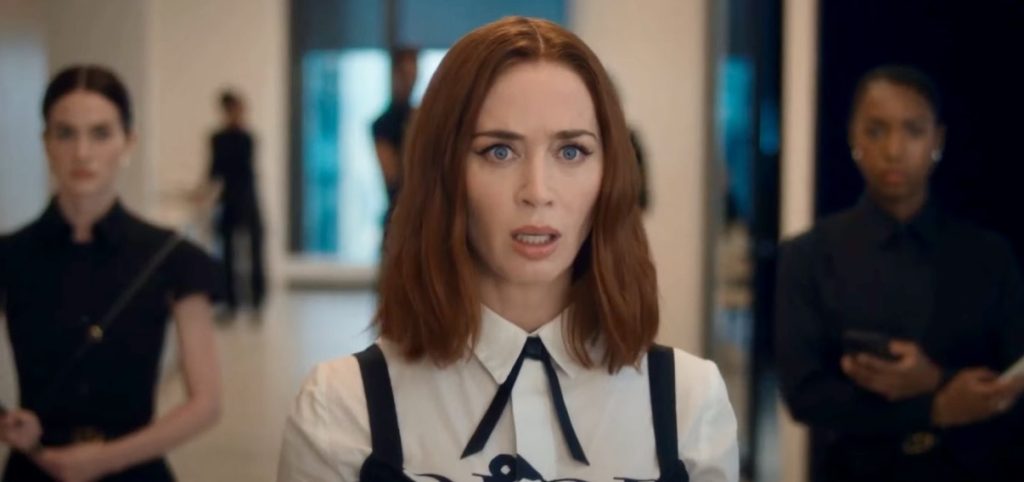
Emily Charlton (Ms Blunt) is, unsurprisingly, a standout. Still acerbic, still scene-stealing, but with a maturity that makes her feel less like comic relief and more like someone who has learned how to play the fashion game on her own terms.
There’s a knowingness to her that works beautifully. And having gone from working at deathly expensive Dior to cost-effective Coach – a serious come down in her mind – is a somewhat antiquated fashion touch. (I mean, isn’t fashion about mixing it all up?)
What the film does well is resist the urge to simply repeat itself. Yes, there are loads of nods to the original, but this isn’t nostalgia for nostalgia’s sake.
It is more reflective and more aware of the industry it’s portraying. Fashion isn’t just about clothes but about business, survival, and staying visible in a world that moves on quickly.
It’s fun and it understands its audience. But more than that, it recognises that the real drama now isn’t getting the job, it’s keeping your place in an industry that’s been rewritten in real time.
I’d recommend to go see it and make up your own mind. . .
That’s all . . .